
Sony A7 V Overview: The Hybrid Camera Perfected?

Disclosure: We feature products and services we think you'll find useful. If you buy through our links, Beyond Photo Tips may earn a small commission, at no extra cost to you. As an Amazon Associate I earn from qualifying purchases. Read the full disclosure.
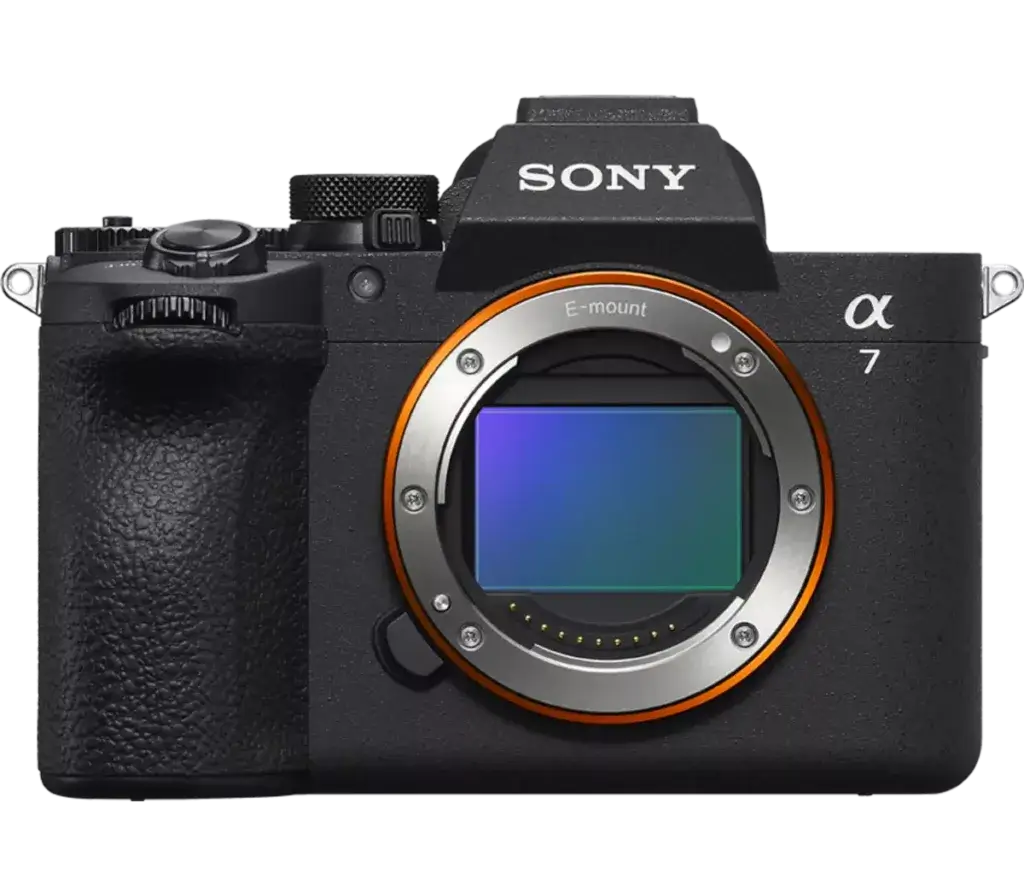
Sony has just announced their new mirrorless hybrid camera: the Sony A7 V (ILCE-7M5). It’s been 4 years since the Sony A7 IV was released. Since then, Canon, Nikon, and Panasonic have delivered mid-range hybrids that have caught up to Sony’s once-dominant autofocus and camera sensor technologies. It was time that Sony answered in kind.
At a launch price of $2,899, the Sony A7 V promises to reclaim Sony’s hybrid crown with a new partially stacked sensor, AI-powered autofocus, and video specs that challenge the competition. This is the most versatile sub-$3,000 full-frame camera Sony has ever made, delivering roughly 90% of the flagship A1 II’s performance at less than half the price.
The Core Upgrades
A New Sensor Architecture
The Sony’s new 33-megapixel partially stacked Exmor RS CMOS sensor maintains the same resolution as its predecessor, but the internal architecture has been completely redesigned with high-speed circuitry layered above and below the sensing layer. The result is a sensor that reads out approximately 4.5 times faster than the A7 IV.
In practical terms, this reduces rolling shutter from roughly 67ms on the A7 IV to around 15ms on the A7 V … nearly twice as fast. This transforms the electronic shutter from a compromised backup option, into a genuinely usable primary mode. Fast-moving subjects no longer exhibit the “jello” distortion that plagued the previous generation, and the maximum electronic shutter speed jumps from 1/8000s to 1/16000s. Quite impressive, in my opinion.
BIONZ XR2 Processor with Integrated AI
Sony’s BIONZ XR2 processing engine, integrates the AI processing unit directly onto the main chip, unlike the Sony A7R V. Previous Sony cameras used a separate AI coprocessor; consolidating these functions improves efficiency, while maintaining the same computational power. Sony claims this enables 60 autofocus calculations per second - half what the flagship A1 II manages, but a substantial leap from the A7 IV.
The processor also enables AI-driven auto white balance that uses deep learning for light source estimation. In mixed lighting scenarios that would confuse conventional AWB systems, the A7 V maintains more consistent, natural colour reproduction - reducing post-production workload considerably.
Speed That Changes Everything
The A7 IV topped out at 10 frames per second. The A7 V triples that to 30fps (electronic shutter) with full AF/AE tracking, blackout-free viewing, and - critically - full 14-bit RAW capture. This is significant: competing cameras like the Canon R6 III drop to 12-bit colour depth at their highest burst rates. Sony maintains full colour fidelity throughout.
Buffer depth depends on your RAW format choice: if you’re using compressed RAW, expect around 85-100 frames at 30fps before the buffer fills - roughly 3 seconds of continuous shooting. While using Lossless compressed RAW halves that to approximately 40 frames. With a fast CFexpress Type A card, the buffer clears within five seconds, and at 10fps, shooting is essentially unlimited.
Finally, Pre-capture makes its way down from Sony’s flagship bodies, allowing the camera to buffer up to one second of images before you fully press the shutter. This is invaluable for unpredictable action. Wildlife and wedding photographers will particularly appreciate the ability to capture the moment just before the decisive instant. Unlike some implementations, Sony offers fine-grained control over pre-capture duration and burst speed.
True Mechanical Shutter Control
One detail that serious photographers will appreciate: the A7 V offers full control over the electronic front curtain shutter. The A7 IV, A1, and A7C2 all use electronic first curtain by default even in “mechanical” mode - problematic for flash photographers shooting above 1/2000s, where bokeh circles become clipped and background blur is reduced. The A7 V can operate with a true full mechanical actuation, preserving optical quality for those who need it.
Autofocus: AI-Powered Precision
The Sony A7 V inherits the 759-point phase-detection autofocus system from the A1 II, covering approximately 94% of the frame. Sony claims a 30% improvement in Real-time Recognition AF performance over the A7 IV, and real-world testing supports this.
Subject recognition now covers six categories: Human, Animal, Bird, Insect, Car/Train, and Aeroplane. The configurable Auto mode can be fine-tuned to look for specific subject types you expect to encounter - eliminating the need to manually switch between modes when transitioning from portraits to wildlife. Definitely a relief.
Human pose estimation has been dramatically improved too. The camera uses detailed form and pose data to maintain reliable eye recognition even when subjects are partially obscured, turned away, or moving erratically. In testing with athletes wearing helmets and gear, the A7 V consistently locked onto eyes when visible and intelligently transitioned to face or body tracking when eyes were obscured - then reacquired eye focus immediately when the subject turned back.
Low-light autofocus extends down to EV -4.0 (ISO 100 equivalent, F2.0 lens), making the camera reliable in challenging conditions where previous generations would hunt or fail entirely. Important to note that the camera also reliably locks on focus in very over-exposed situations, where previous models would fail.
Image Quality and Dynamic Range
Sony claims up to 16 stops of dynamic range from the new sensor - a figure that, while difficult to verify precisely, does translate to visible improvements in real-world shooting. Shadow recovery is noticeably cleaner than the A7 IV, with less noise and colour shift when pushing underexposed areas. Highlights roll off more gracefully, preserving detail in high-contrast scenarios like backlit portraits or wildlife against bright skies.
The sensor appears to use a dual-gain architecture, though Sony hasn’t officially confirmed the specific ISO transition points, as usual. Reviewers have noted cleaner high-ISO performance, with some suggesting a second native ISO around ISO 8000. Regardless of the technical implementation, the practical result is that the A7 V handles low-light shooting with noticeably less noise than its predecessor.
One caveat: dynamic range is slightly reduced when using electronic shutter compared to mechanical. The difference isn’t dramatic, but photographers seeking maximum shadow recoverability should stick to mechanical shutter when the situation permits. This is consistent with other partially stacked sensors on the market.
The 33-megapixel resolution remains a sweet spot - high enough for significant cropping and large prints, but not so dense that it punishes slight technique errors. Files are manageable, and the camera includes a new lightweight RAW format that achieves high image quality in smaller files. The quality of these files will be apparent only once apps like Lightroom Classic, and Capture One add compatibility for the A7 V.

Video: A Genuine Hybrid at Last
The Sony A7 IV was criticised for video that didn’t match its photographic capabilities. The A7 V corrects this comprehensively.
Recording Modes
Full-frame 4K at 60fps is now available with no crop, oversampled from 7K capture for exceptional detail. The A7 IV could only manage 4K60 with a 1.5x crop; the A7 V eliminates this limitation entirely. Rolling shutter in 4K60 measures around 13-14ms - fast enough that jello is effectively a non-issue for most shooting scenarios.
For high-speed work, 4K 120fps is available in APS-C/Super 35 mode with a 1.5x crop. 1080p extends to 240fps for dramatic slow-motion. All major frame rates support both H.264 and H.265 codecs, with options for 4:2:2 10-bit recording at higher bitrates.
One quirk worth noting: to achieve full-width 4K60, you must enable “4K Angle of View Priority” mode, which disables in-camera noise reduction. The impact on image quality appears minimal, and many users prefer to handle noise reduction in post anyway, but it’s worth understanding the trade-off.
Stabilisation and AI Features
In-body stabilisation is rated at 7.5 stops centrally and 6.5 stops at the frame periphery - a significant improvement over the A7 IV’s 5.5 stops. For video, Dynamic Active Mode combines optical and electronic stabilisation for smooth handheld footage, though it does introduce a crop.
Auto Framing uses AI subject recognition to automatically crop and follow subjects during recording - ideal for solo creators who need a virtual camera operator. You can configure framing tightness and tracking speed to suit your style. A Framing Stabiliser option maintains your chosen composition on a selected subject even while the camera is moving.
Custom LUTs can now be imported (.cube format) for preview and embedding alongside footage. S-Log3 and S-Cinetone colour profiles are included, along with improved in-camera noise reduction for the internal microphone.
Thermal Performance
Perhaps the most impressive video-related improvement is thermal management. Despite lacking a fan, the A7 V uses a sigma-shaped graphite heatsink integrated into the IBIS unit that allows extended recording in demanding modes.
In controlled testing at room temperature, the camera recorded 4K60 continuously for over six hours without overheating (tested by Gerald Undone) - extraordinary for a fanless body. Sony rates the camera for approximately 90 minutes of 4K60 at 20°C and 60 minutes at 41°C. For comparison, the A7 IV would overheat in just over an hour under similar conditions. This is easily the best thermal performance in any fanless camera that we’ve seen to date.
What’s Missing
The A7 V lacks Open Gate recording - a feature increasingly common on competitors like the Panasonic S1 II and Canon R6 III. Sony’s position is that their target buyer doesn’t need it, though the sensor appears capable of the mode. For creators who regularly deliver both 16:9 and 9:16 content, this may be a consideration, though the practical impact of OpenGate Recording is arguably overstated … shooting slightly wider achieves the same “headroom” without the trade-offs in read speed and bit depth that Open Gate modes typically impose.
Internal RAW video and DCI 4K are also absent, as are exposure assistance tools like waveforms and false colour. Dedicated video shooters may find competitors more fully-featured; the A7 V is best understood as an exceptional hybrid rather than a dedicated cinema camera.
Body, Build, and Ergonomics
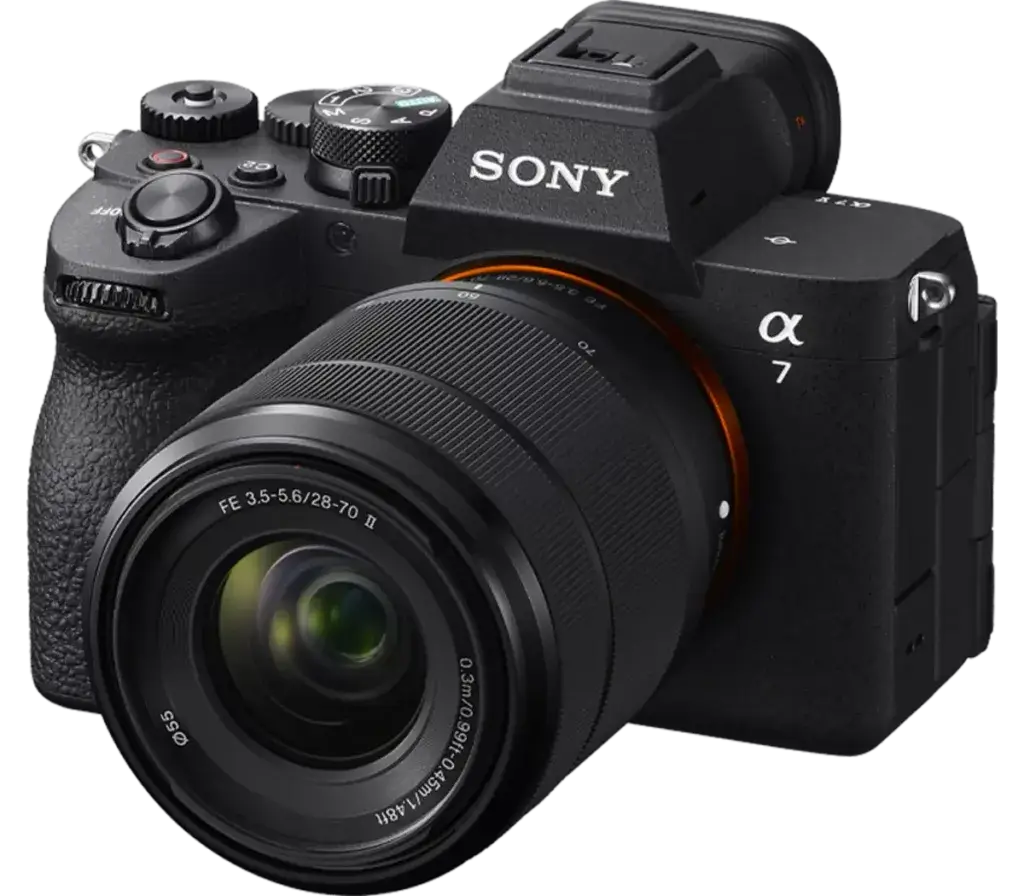
Externally, the Sony A7 V closely resembles the A7 IV, maintaining the same control layout and general dimensions. The key physical upgrades are practical rather than dramatic.
The rear screen inherits the amazing 4-axis multi-angle mechanism from the A1 II - tilting up 98°, down 40°, and opening sideways 180° with 270° rotation. This hybrid design is great for both stills shooters who prefer tilting screens and video creators who need full articulation. The panel itself is larger, at 3.2 inches with 2.09 million dots - double the resolution of the A7 IV’s display.
Dual USB-C ports replace the previous USB-C/Micro USB combination. The upper port supports SuperSpeed USB 10Gbps for fast data transfer and tethering. The lower port handles power delivery, and offers USB 2.0 speeds. This allows simultaneous charging and high-speed data transfer - useful for extended studio sessions or live streaming.

The grip has been refined for improved comfort, though it doesn’t gain the tilted shutter button design of Sony’s pro bodies. The magnesium alloy chassis maintains weather sealing and durability, with the mount secured by six screws for heavy lens support - all of this is expected.
The viewfinder remains unchanged at 3.69 million dots - adequate but not class-leading. Competitors like the Panasonic S1 II offer 5.76 million dot EVFs. For photographers who spend significant time with their eye to the finder, this may be the camera’s most notable compromise.
Battery Life and Connectivity
The Sony A7 V uses the same NP-FZ100 battery as previous generations but achieves roughly 20% better efficiency thanks to the new processor that essentially combines the earlier dual processors + AI sub-processor into a single chip. CIPA ratings show 630 shots using the viewfinder and 750 shots using the rear screen. These are impressive figures, but figures that typically underestimate real-world performance.
A new Monitor Low Bright mode dims the screen during idle periods rather than putting the camera to sleep, reducing the power needed to wake the camera while keeping it ready for instant shooting. It’s a small refinement that adds up over a long day of shooting.
Wi-Fi 6E (2.4/5/6GHz) enables faster wireless transfers - important for news and sports photographers who need to deliver images immediately. Bluetooth 5.3 handles background connectivity for the Creators’ App, which provides remote control, file transfer, and cloud storage integration.
Key Specifications
| Specification | Sony A7 V Spec |
|---|---|
| Sensor | 33MP full-frame partially stacked Exmor RS CMOS |
| Processor | BIONZ XR2 with integrated AI processing unit |
| ISO Range | 100–51,200 (expandable 50–204,800) |
| Autofocus | 759-point phase-detection, 94% coverage, EV -4.0 |
| Subject Recognition | Human, Animal, Bird, Insect, Car/Train, Aeroplane, Auto |
| Burst Rate | 30fps (e-shutter, 14-bit RAW), 10fps (mechanical) |
| Pre-Capture | Up to 1 second, configurable duration and burst speed |
| Shutter Speed | 30s – 1/8000s (mech), 30s – 1/16000s (e-shutter) |
| Image Stabilisation | 5-axis IBIS, 7.5 stops (centre) / 6.5 stops (periphery) |
| Video: 4K | Up to 4K60 full-frame (7K oversample), 4K120 APS-C crop |
| Video: 1080p | Up to 240fps |
| Video Codecs | XAVC HS (H.265), XAVC S (H.264), XAVC S-I (All-I) |
| Viewfinder | 3.69M dot OLED, 0.78x magnification, 120fps option |
| Rear Display | 3.2” 2.09M dot, 4-axis tilt + full articulation, touch |
| Memory Cards | 1× CFexpress Type A / SD, 1× SD (UHS-II) |
| Connectivity | 2× USB-C (10Gbps + PD), HDMI-A, mic, headphone, Wi-Fi 6E |
| Battery Life | 630 shots (EVF) / 750 shots (LCD) – CIPA |
| Dimensions | 130.3 × 96.4 × 82.4 mm (5.13 × 3.80 × 3.24 in) |
| Weight | 695g / 24.5oz (with battery and card) |
| Price (Body Only) | $2,899 USD / £2,799 GBP |
Competitive Landscape
The Sony A7 V enters the most competitive segment of the mirrorless market. At similar price points, the Canon EOS R6 III ($2,799) matches the 33MP resolution and offers Open Gate recording, internal RAW video, and arguably superior IBIS rated at 8.5 stops with stabilised lenses. However, its non-stacked sensor exhibits more rolling shutter, and burst shooting drops to 12-bit colour depth at maximum speeds.
The Panasonic S1 II ($3,199) appeals to dedicated video shooters with 6K internal RAW, Open Gate, and exceptional IBIS performance. Its 24MP partially stacked sensor is fast but offers less resolution for cropping. Autofocus, while improved, still trails Sony’s subject recognition in challenging scenarios.
The Nikon Z6 III offers a partially stacked 24MP sensor at a lower price point, with excellent autofocus and a compelling lens ecosystem. For photographers who don’t need the extra resolution or video flexibility, it remains strong value.
Against Sony’s own lineup, the A7 V sits interestingly. The Sony A1 II ($6,499) offers 50MP, 120fps burst, and faster processing, but at more than double the price. For most hybrid shooters, the Sony A7 V delivers 90% of that capability at a far more accessible price point.
Who Should Buy the A7 V
Upgrade from A7 III or A7 IV: The A7 V represents a substantial leap. The combination of dramatically improved burst speed, superior autofocus, better video, and enhanced thermal performance makes this a worthwhile upgrade - especially if you’ve been bumping against the A7 IV’s limitations in action or video work.
Wildlife and sports photographers on a budget: Previously, Sony shooters needed the Sony A1 or Sony A9 series for serious action work. The A7 V brings 30fps burst, reliable subject tracking, and pre-capture to a sub-$3,000 body for the first time.
Hybrid creators: If you need a single camera that excels at both stills and video without compromise, the Sony A7 V is one of the most balanced options available. Full-frame 4K60 with excellent autofocus and thermal performance makes it genuinely usable for extended video work.
Wedding and event photographers: The improved dynamic range, reliable eye tracking even in challenging conditions, and extended battery life make the Sony A7 V well-suited for long event days where consistency matters.
Who Should Look Elsewhere
Dedicated video professionals: If Open Gate, internal RAW, and pro video tools are essential, the Panasonic S1 II or Canon R6 III offer more complete video feature sets. The A7 V is a hybrid first, video camera second.
Resolution-focused photographers: If you need maximum detail for large prints or heavy cropping, the Sony A7R V’s 61MP sensor remains the better choice, despite its speed limitations.
Those satisfied with current gear: If your A7 IV meets your needs and you’re not hitting its limitations, there’s no requirement to upgrade. The best camera is still the one you have when the moment happens.
The Verdict
The Sony A7 V is the camera the A7 IV should have been - and then some. By combining a fast partially stacked sensor, mature AI-powered autofocus, comprehensive video capabilities, and exceptional thermal performance, Sony has created what may be the most well-rounded hybrid camera on the market.
It doesn’t win every category. Canon offers better IBIS and more video flexibility. Panasonic delivers superior tools for dedicated filmmakers. The EVF could be higher resolution. But no competitor matches the Sony A7 V’s overall balance of photo and video capability at this price point.
Four years ago, the Sony A7 IV set the template for the enthusiast hybrid. Since then, rivals have caught up and, in some areas, surpassed it. The Sony A7 V doesn’t just reclaim Sony’s position … it establishes a new benchmark. For photographers and creators who need one camera that does everything well, this is the one to beat.
Pricing and Availability
Body only: $2,899 USD / £2,799 GBP - Available late December 2025
Kit with FE 28-70mm f/3.5-5.6 OSS II: $3,099 USD - Available February 2026
FE 28-70mm f/3.5-5.6 OSS II (lens only): $449 USD - Available February 2026
Related Posts

Photography Calculators: Seven New Tools and a Refresh for the Originals
Our free photography calculators have grown from four to eleven: field of view, golden hour, astro, time-lapse, macro, ND filter and flash, plus refreshed originals.

4 Essential Photography Calculators Every Photographer Should Bookmark
Use these free photography calculators to figure out how to improve your images online. Figure out Print size, Depth of Field, Dry Silica Gel, & more.
Canon EOS R5 Mark II Specs
Canon announced their update to the EOS R5, the EOS R5 Mark II today. As expected, the specs are a step up from the original R5. The sensor size is the same, though it is a new sensor with higher readouts. The Auto-Focus…

Link Roundup #001
Welcome to Beyond Photo Tips' very first photography link roundup. In this brand new series of weekly posts, we are going to bring you, a glimpse of everything that we found interesting in the week gone by.