Beyond Phototips

Avatar

Photography for the Serious Amateur.

Photo Project: Going Retro With Your Camera

by Susheel Chandradhas

A few days ago, I wrote about how to retrograde your dSLR, and turn it into something a bit more dated. Yes, a strange thing to do…

Now, we’re going to look at how you can use that retro dSLR to improve your photography skills and the way you think when you have a camera in your hand.

Your dSLR has a lot of features that help you get your image ‘just right’. Take the modern gadgets away, and you’re back with the fundamentals of photography; and that’s not going to change. Even in the distant future.

Why go back?

Pushing your camera back to the “old days” will:

  1. Make you understand the mechanics of taking a photograph.
  2. Improve your awareness of the composition in your frame.
  3. Help you visualise what you want to capture.
  4. Show you the difference between your visualisation and the actual capture. (practise will make you better at reducing this gap).
  5. Enable you to make the most out of your camera when it is back in ‘regular dSLR’ mode.
  6. Confuse the hell out of you for a while. (For sure, if you’ve never shot in full manual before.)

Guidelines

Some simple guidelines for the project.

  1. Retrograde your camera as described earlier… or use an old Film SLR.
  2. Try not to use any automatic modes, and do not look at the LCD display for anything.
  3. Learn the Sunny 16 ruleBrian Auer’s Sunny 16 guide is brilliant.
  4. Take only 36 photographs in a session. Do not cheat by deleting pix.
  5. Do not. I repeat “DO NOT” look at the photographs until you download them on your computer.
  6. Only use simple retouching techniques at first… Basic “Levels” or “Curves” Photoshop adjustments.

Step-by-step project walkthrough

Step1:

You’re in the dark when it comes to correct exposure (unless you have prior experience). This is because our eyes are so good at adapting to the light that is available to them. A well lit room could look easily look as bright as daylight in summer even though it is not.

Use the Sunny 16 Rule to guide you, and take photographs in sunlit places. Unless you want to live dangerously.

Step2:

Consider every single exposure. Really look at the composition, study the light that’s falling on the object, calculate exposure based on the sunny 16 rule, note the background, take a breath, and gently depress the shutter release.

Remember that you’re only taking 36 photographs for this project. If you take a picture, don’t delete it.

Restricting yourself to a low number of photographs makes you think about the subject:

  1. Is the subject worth photographing? Ditch it if you think you’ll get better subjects.
  2. Have I got the best angle? Try different angles till one looks great.
  3. Is the light right? Come back when you think it’ll be right.
  4. Have I set the right Focal Length, Aperture and Shutter speed? Only time will tell :D

Step3:

Try really, really hard not to look at the photographs before they download. This is the hardest part for many of us. If you’re on a Film SLR, you’ve got to wait anyway, so skip this step.

Step4:

Download your photographs, or get them printed at the photo-store. Analyse the pictures, and re-live the moment in which it was snapped. If you were to take that photograph again, what would you do differently? Log these notes in your memory for future use.

If you do retouch these photographs, try to keep the retouching light in an effort to maintain the original feel.

Step5:

Pick a photograph, either because it came out exactly how you envisioned, or because it failed miserably. Tag it “BP-retro” and share it in our Beyond Phototips Flickr Group, or you could write a blog post about it. Alternatively, you could simply post in in the comments, right here… But do explain what you were trying to do, and whether you succeeded or failed.

I’ll be participating too, so expect to see my misfired pictures in the near future.

Wrapping up

I’ll compile all the photographs that are shared on this website, or in the Flickr group and share them in a post two weeks from now, around the 9th of December. Submit your entries before that. If you write a blog post, mail me from the contact page if you want it posted.

Note: This sort of limited-frame shooting is best tested when on a photowalk. In that case, limit yourself to about 72 frames. The equivalent of two rolls of film.

Share this Phototip:
  • Digg
  • del.icio.us
  • StumbleUpon
  • Facebook
  • Twitter

Photo Project: Symmetry

by Susheel Chandradhas

In order to take you photography to the next level, there are some things that you must consider. Photography is a skill; but at some point that skill must be overcome by aesthetic considerations in order to be considered ‘art’. Lets start off with a simple project. One that everyone could take part in, that will help you develop your photographic eye, and help you stock up your photographic bag of tricks.

Symmetry

Symmetry is a key element of nature itself, and more importantly to us, in man, and his creations. In your composition, and in your subject, symmetry brings out simplicity amongst complex shapes, and makes things easier to understand.

Symmetry is everywhere. It is when you look at a perfect square, or a bar of chocolate, when you push all your chairs in at your dinner table, or when you look at a racing car. You see it in your architecture, in domes, in arches, in staircases and in doors. You see it in your computers and cellular phones. It is possible that it also makes things more beautiful to behold, and is hard to ignore once you start looking around… Symmetry is everywhere.

Symmetry is not always the best choice for a subject though, and knowing when to use symmetry to enhance the features of the subject, or the subject of your photograph is something that comes with practice and a critical eye.

Take Part – Show off your Symmetry

To be part of the Photo Project, take three photographs with the theme ’symmetry’ kept in mind. Upload them to Flickr, and add them to the Beyond Phototips Flickr Group with the tag “BPP-symmetry“.

10 days from now, I’ll pick at least one photograph from every participant’s submissions and post them all up here on Beyond Phototips for everyone to see. So be on your toes, and think before pressing that shutter-release button. You don’t want to be showing off anything but your best work, right?

If  you find the process interesting, why not write about it and put it up on your blog so that others can benefit too? If you’ve got any thoughts to share, but just want to jot them down quickly, do leave a comment at the bottom of this post.

Some Examples of Symmetry in Photography

Not all books are burned

Creative Commons License photo credit: Netream

wall & doors

Creative Commons License photo credit: goandgo


Share this Phototip:
  • Digg
  • del.icio.us
  • StumbleUpon
  • Facebook
  • Twitter

Competition Winners

by Susheel Chandradhas

Finally, I’ve been able to properly evaluate and publish the winners of the Beyond Phototips Detail Everywhere competition. We received an un-expected 43 entries, each of them showing your expertise and fondness for photography.

Now, here are the winners; without further ado.

The Winners

First Place

Explorer by aaronkoolen

First Place: Explorer by Aaron Koolen

Third Place

Hands of Time by Ananda Niyogi

Third Place: Hands of Time by Ananda Niyogi

Congratulations Aaron Koolen, Gunjan Karun and Ananda Niyogi! You have all won copies of “Fundamentals of Photography” by Tom Ang from the publishers and Aaron has won a $50 Amazon.com gift voucher from BeyondPhototips.com. You have been contacted on flickr and have been requested for your contact details please respond to that message.

Selecting the winners

Selecting the winners was not easy. I wanted to offer a fair chance, un-biased by my personal tastes and prefernces so I got 5 other people whose tastes and opinions varied based on background, age and even profession and asked them to rate each photograph based on 4 criteria. The results were tallied and the images you see above were the winners.

EDIT: I neglected to mention that it was not easy, choosing the winner. 6 judges (me plus 5 others) meant 6 different opinions. The images submitted did not make the choice any easier… I had to tally them up to see which pictures were rated the most and among them which were rated the highest. However, in the end the winners were clearly the ones you see above. Congratulations.

Late announcements

I’m aware that many of you were eagerly awaiting the results of this competition. You have mailed me and left comments on the blog. I do apologise for the delay. Unfortunately, it was un-avoidable. You can, however, expect Beyond Phototips to keep giving you your regular dose of photography tips once again.

Share this Phototip:
  • Digg
  • del.icio.us
  • StumbleUpon
  • Facebook
  • Twitter

Upgrade Photographs / Downgrade Equipment? What’s up?

by Susheel Chandradhas

Photo By:Bruna MirandaYesterday, I upgraded and I downgraded. I upgraded from a standard Free Flickr Account to a Pro Account, and I downgraded from my Canon 5D with L series lenses (stats) to my old Konica-Minolta Dimage A2 (stats) dSLR-like camera. So what’s the deal?

I’d found that I was restricting the images that I posted on Flickr to a great degree. Now, while that is a good thing to do, and while it does give you the compulsion to show off only your best work, it also makes me restrict my images to under 200 in total and I’ve not been posting much because of that. Now that I’ve jumped in the pool (with a measly $25), I’m going to have to post photographs more frequently, and of course, keep increasingly my image quality.

I did say “Increasing My Image Quality” just now, didn’t I? So why am I downgrading my camera? It seems illogical even to me. However, I do believe in this little post I made some time ago entitled “Its the photographer, not the gear” Where I boldly stated that a better camera does not equal a better photograph.

I’m going to put that statement (and my photography skills) to the test. In the next few months I’m going to re-explore my photography and put up photographs taken for the most part on my trusty Konica Minolta Dimage A2 (even though I have some brilliant Film Cameras and two Canon 5D bodies at home).

Why?

Its going to be an exercise in seeing differently. True, seeing things on a dimly lit LCD based viewfinder system, but its a restriction that I want to work with. It means that I wont be able to see the picture I’m taking properly in broad daylight (the LCD sucks in daylight, so I’ll have to use its measly LCD based viewfinder). It means I wont be able to change my lenses much. But again, why all the pain? Afterall, a Canon 450D or even a Canon 40D is quite affordable.

Here’s why

My work over the last few months has undergone a dramatic change. From mostly taking photographs alongside my Dad, I’ve moved to making websites.

Why would anyone choose websites over taking photographs? Because its a new challenge for me, and one that I’ve been wanting to explore for years!

Well, its resulted in me sitting in office and slouching over my computer for days on end. Its taken a toll on me (and by extension, this blog). I’ve not been seeing much of the outside world :-P .

I’m still going to be huddled over the computer for a great portion of my day, but I’ve decided that at least a part of it is going to be dedicated to photography and the outdoors.

What can you expect?

Well, I think you can expect me to be thinking of photography a bit more in the months to come. Hopefully, I’ll also be able to get down to posting my thoughts about photography and some of the new insight I gain in making the shift from Pro photography, to lay photography (strange deal, dont you think).

I hope you’ll stay with me through this odd journey to share my strange world.

You’re welcome to check out my Photographs before the deal on flickr.

If you come by later on, here are my most recent photographs on flickr.

Share this Phototip:
  • Digg
  • del.icio.us
  • StumbleUpon
  • Facebook
  • Twitter

Get ‘em to look through the Lens at You

by Susheel Chandradhas

Serious By TopGun2000Photo: TopGun2000What makes the most powerful portraits powerful? What makes them stand out and look you in the face? Why do you feel like the person is looking at you, with meaning?

Possibly because they looked at the photographer, through the lens.

When you’re taking portraits, the most difficult thing to do, and the most important, is to get a great connection between you and the sitter.

After all, your intention is to convey the personality of the person in front of the lens. How do you do this? They’re usually pre-occupied with the makeup, their hair, their clothes… whether you’re going to show them as they are, or going to show them as they don’t want to be shown… How do you get them to get out of their shell, so that you can get “The Shot”?

WHEN DO YOU GET ‘THE SHOT’?

When your sitter looks at you… Not at the camera, not at the lens, not at a black something… When the sitter looks at you; through the lens! Then you’ve got it. That’s when your connection with the sitter comes through… Through the lens, to the photograph. It gives them life, it gives them personality, it makes the photograph real.

HOW DO YOU DO THAT?

Keep it real. Keep that inter-personal connection real. Make it last. If you don’t care, its apparent that you don’t really care about your work; they’re not going to either.

Get the technique out of the way. If you’re constantly fiddling with the lights, or your camera, your sitter is constantly reminded of the unnatural situation that they’re in… In front of the lights, or in front of a camera. It only helps them get more nervous. Get your technique worked out in the days before the shoot, and you’ll be able to focus more on that connection!

Make them laugh. Laughter helps create a bond, especially when the time in which to create that bond and bring out those really interesting expressions is very limited. Keep your session light hearted, and you’re likely to gain their trust; and get that photograph.

Take a lot of photographs. If you take only a few photographs, its likely that each of those photographs is going to become an “event”, bringing your sitter’s focus back to the camera, and not to you. When you become the “event” then the sitter is more likely to look at you. Not the camera, not the lens… you can take a cue from the previous tip.

I was the joke(r) by Simon PaisPhoto: Simon Pais-ThomasLet them loosen up. Usually, the best shots from a session happen towards the end. Unless the sitter is a professional model, its always difficult to open up and be themselves. Being in front of the camera is difficult if you’re not experienced. Get the sitter to talk, chat, tell a few jokes, let them loosen up and lose that rigidity!

Let it go… Some people just don’t like to be photographed. They may have come to you for a portrait, or for a commercial shoot, but sometimes, they just don’t have what it takes to be themselves in front of the lens. This is usually where the photographer’s people skills and experience comes in to play, but sometimes, you just cant get a photograph with real connect, because they’re not connected! So let it go.

This post was inspired from an interview with British Celebrity photographer Rankin (some of it NSFW) do head over to his website to read the full interview and see his brilliant work.

Here are some links to some beautiful portraits with connect.

Here are a couple more links to get you started off on your portrait photography!

I hope that this gets you started off on some really interesting portraits. We’d love to hear from you if you have some more ideas… Do mail me, or leave a comment.

If you liked this post, and would like to receive more like it, do subscribe to the Beyond Phototips RSS feed.

Share this Phototip:
  • Digg
  • del.icio.us
  • StumbleUpon
  • Facebook
  • Twitter

Photo Project: The Urban Alphabet

by Susheel Chandradhas

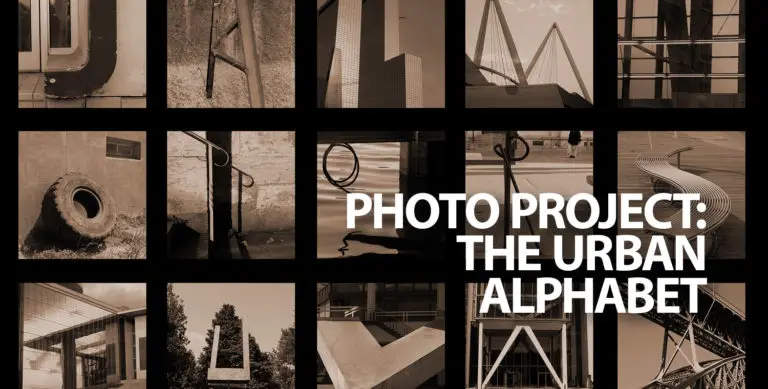
Urban Alphabet
Cities provide us with a wonderful resource in juxtaposed objects. Magnificently textured drain covers from a different era next to a modern paving and street markings, an ultra-modern skyscraper freshly sculpted out of the earth, yet forever posed against the immortal sky… they’re all there for the taking.

This project intends to test your skill at seeing these juxtapositions, to fashion shapes that have meaning to us in language, out of shapes (objects) that are intended for other purposes. You could also do variations of this, and create an urban alphabet out of interesting lettering that you see around you in the city.

For this project, you will have to look at lines, outlines, textures, parts of objects, and techniques that you can use with your camera (such as using depth of field) to take shapes that are not quite what you want, and re-shape them into the english alphabet.

Try to find a diverse range of things to work with. Try macro, landscape, square crops, diagonal frames, whatever it takes… The idea is to see everyday objects in a new light.

You can find more such projects at the Photo Project home page.

Pic: maloupictures

Share this Phototip:
  • Digg
  • del.icio.us
  • StumbleUpon
  • Facebook
  • Twitter

Continue Next page

Featured Series

Looking for something more? Take a look at these series of posts that Beyond Phototips is running right now.