
Polarizing Filters Make Magic Moments
Table of Contents
There’s a technical aspect to using a polarizing filer, but there’s a visual aspect that you really have to experience if you are a photographer. Have you experienced a Polarizing filter yet? If you have not, I seriously recommend trying one today. Do not delay.
Yesterday I was contemplating stuff … you know, looking through my memory bank of photographic experiences, when I suddenly stumbled upon a gem!
My First Encounter With Polarizing Filters
The first time I looked through a telephoto lens with a polarizing filter at the other end … it was MAGIC! The world was different; the sky was a darker shade of blue, the leaves were a richer green and wonder of wonders, the lake surface I was looking at was clear!
That was my first Pola-Magic moment.

My Second Encounter
The second was a bit more ‘impersonal.’ It didn’t happen to me in person. But that didn’t take away any of the magic. It was on TV. Discovery channel, I believe, and I was watching a program about wildlife.
The image on the screen was that of a dolphin (or maybe it was a shark or a killer whale, I got lost in the magic and forgot what exactly they were following) and it seemed like it was being photographed by some new kind of underwater camera until suddenly it broke the surface to breathe and I noticed that splashes of white foam broke to the sides of the animal. The image was actually of the creature from the air. It was magic!
Here I was, thinking for all this time that the animal was being followed by an under-water camera when in fact it was being shot by a cameraman in the air, suspended a couple of hundred feet above the animal (yes, I know its stupid not to recognise the angle of the shot, but did I mention Magic?). The photographers themselves were talking about the magic of the moment, and then the magic was revealed.
They were using a polarizing filter on the camera. My second Pola-Magic moment.
Polarizing Filters: How Polarizing Filters Work
Now, there’s something else that I have to mention about polarizing filters, but that involves a bit of a technical discussion about how polarising filters work in the first place. I assure you, it will be to the point and will help you with your experiments with Polarizing filters.
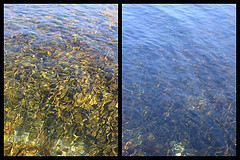
When light from the sun strikes an object, it becomes naturally polarized. All the rays come from the same source, and as a result the waves are oscillating along the same axis. Now, when they strike an object, the rays scatter, shifting the plane of the waves and scattering light. Polarizing filters work by allowing only light waves that are oscillating on one particular plane to pass through. This means that reflections are naturally removed, because reflections are formed by light rays reflecting off a different surface - and therefore, have a different light ‘source’ - and most likely have a different axis of oscillation.
How To Use Polarizing Filters
Polarizing filters come in two types:
- Linear Polarizing Filters and
- Circular Polarizing Filters.
The linear kind was given up with the advent of auto-focus cameras because of the way that the AF in the cameras worked. The circular polarizer is designed to work with AF mechanisms and still let you have great Pola-Magic moments.
They’re neutral filters in the sense that they don’t add any colouring to the image. When used correctly, they increase the saturation and vividness of the colours in your frame, clouds in the sky are better defined, leaves are a richer green and just about everything looks nicer.
Here are some tips to help you when using a polarizing filter:
- A polarizing filter is a very interactive one. It’s not one that you just screw on and forget about. You need to keep adjusting it to get the best results.
- Polarizing filters don’t work very well with wide-angle lenses. They tend to darken only certain parts of the sky and leave other parts bright. This could leave you with a patchy sky. Not a good thing, unless you like it that way.
- Polarizing filters will not remove reflections from mirrors or reduce reflections on metallic surfaces.
- A polarizing filter is made of two parts. A screw-in mount to attach it to your lens, and a filter housing that is firmly - yet freely turning - attached to the screw-in mount.
- When using the polarizing filter, first compose the frame as you want it.
- Turn the filter once you’ve composed the frame until you get the desired polarizing effect. It is most effective at a 90-degree angle to the sun.
- Remember that a polarizing filter typically reduces the amount of light that goes through it by around two f-stops. This makes it a bad idea to use it in dimly lit situations. It also means that if you’re using a camera that does not have Through The Lens metering (TTL), you’ll have to open up by roughly two f-stops. This is a number that you’ll have to arrive at by trial and error.
Find Polarizing filters on Amazon.com. Or, if you have one in your bag, get it out and start shooting!
Do you have some other tips about polarizing filters that you would like to share? Do leave a comment or mail me.
Related Posts

PPI, DPI, and LPI: What Actually Decides Print Sharpness
If you have ever sent a photo off to print and felt a small knot of worry that it might come out soft or blurry because you got the settings wrong, then you have probably bumped into these acronyms. PPI. DPI. LPI. Ask…

How to Harness the Power of Texture To Improve Your Photographs
Textures in Photography are all about giving your photograph a real, tangible, and tactile feeling, and depicting it visually with light and shade.

How Can I Get Better at Photography?
Learn how to get better at photography with clearly defined steps. This is a definitive guide to improve your photography written by experts.

How Can I Use DMF on My Sony Alpha Camera?
In Sony Cameras, Direct Manual Focus (DMF) is a hybrid of auto and manual focus modes. It's incredibly useful for quick, but nuanced focus control.
8 Comments
Comments are closed.
Yanik
This is a quick and easy explanation! Great job. Your example are clear and visual. :)
andyP
All so true. After my UV filters which are my default lens protectors, my polarizers are my most important filters.
Before you go out to buy a polarizing filter you should know that there are two distinct types. The older type is linear (referred to as a 'polarizing filter") and the newer kind is a circular polarizing filter (CP). Autofocus systems will not work properly with the older type. In other words, if your camera is autofocus, your polarizing filter should be a circular polarizer.
I find that there is less difference as you rotate a circular polarizer, although they, too, are mounted in rotating mounts.
And since the whole point of polarizing filters is to enhance clarity, color, etc - your new filter should feature an anti-relflective coating.
And one more thing - polarizing filters and polarized sunglasses are not a good combination. Take off your sunglasses before setting up that pola-magic shot.
Joe
Does #1 have a typo?? "A polarizing filter is a very interactive one. It’s one one that you just screw on and forget about. You need to keep adjusting it to get the best results."
one one?
Also how does one tell a circular polarizer from a non-circular polarizer (i.e. at a garage sale??)
Susheel Chandradhas
Joe,
Yes, that was a typo and I've fixed it. Thank you.
Well, usually a Linear Polarizer will be marked "PL" on the filter ring. Circular Polarizers are marked "CPL". Visually they both seem the same to me.
Hope that helps.
Joe
thanks. good post
Susheel Chandradhas
@joe: Glad you like it.
Cheers!
Alonso Hovden
It is such an important subject and overlooked by too many bloggers, even experts. I thank you for your help getting people more educated about that topic.
Julius
I know it's 2 years too late, but for any others who find this via Google, I just found this on Wikipedia for how to distinguish circular polarizers from linear ones:
(http://en.wikipedia.org/wiki/Polarizing_filter_(Photography))
"Linear polarizing filters can be easily distinguished from circular polarizers. In the former, the polarizing effect is the same regardless of which side of the filter the scene is viewed from. In the latter, the polarizing effect is quite marked when the scene is viewed from the male threaded side of the filter, but almost non existent when viewed from the other side."